Why the Type of Torque Wrench Matters
A torque wrench is one of the most important tools for jobs where fastener tightness matters. Lug nuts, suspension components, engine parts, wheel bearings, trailer hardware, and many other assemblies may require a specified amount of torque.
The goal isn’t simply to make a bolt “really tight.” The goal is to tighten it to the specification established for that application without leaving it loose or overtightening it.
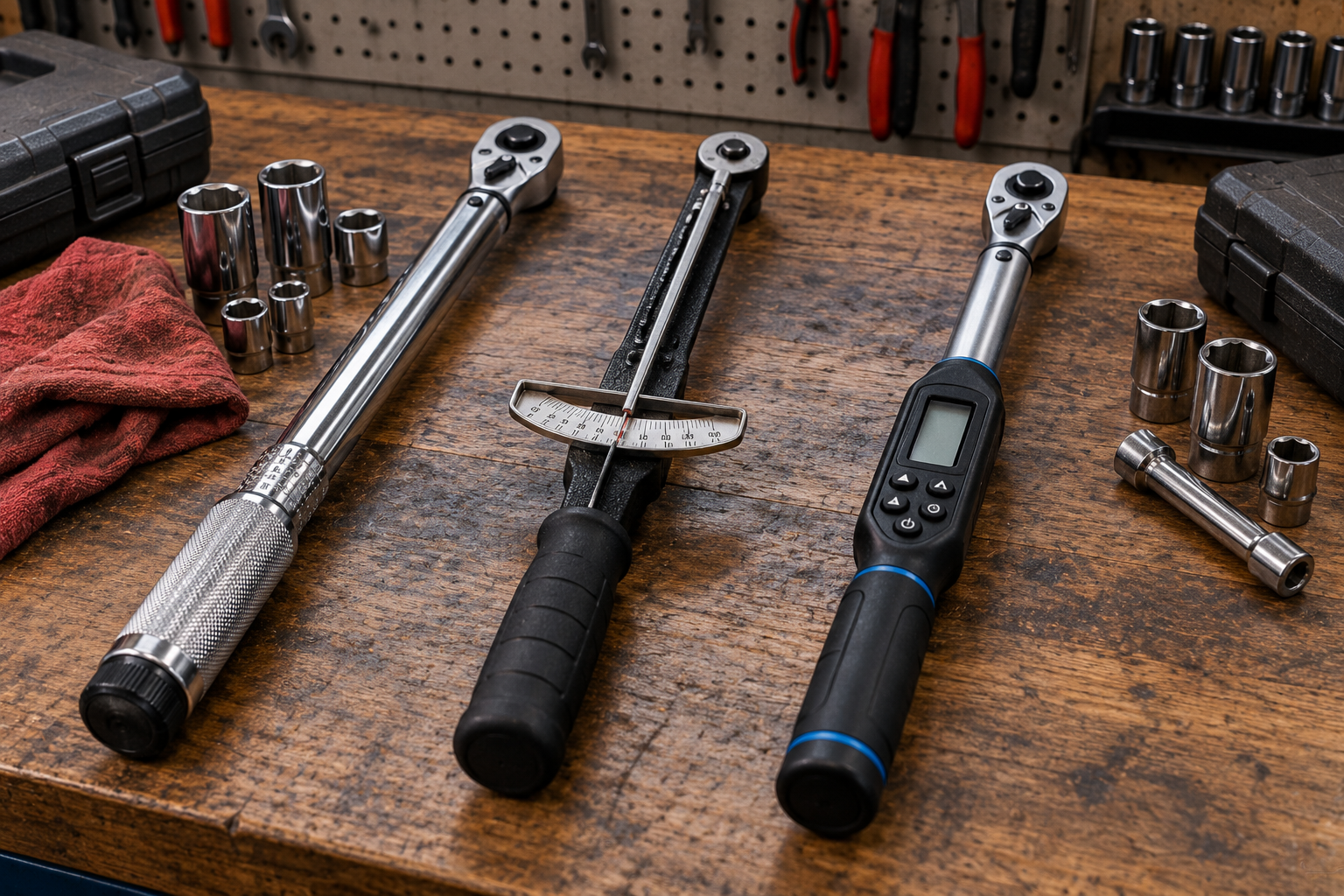
Several types of torque wrenches are available, but three of the most common choices for truck, trailer, and general shop work are click-type, split-beam, and digital torque wrenches.
Each has advantages and disadvantages.
What Does a Torque Wrench Actually Measure?
Torque is rotational force. In automotive work, torque specifications in the United States are commonly expressed in pound-feet (lb-ft or ft-lb) or pound-inches (lb-in). Newton-meters (N·m) are also commonly used.
A torque wrench allows you to apply a controlled amount of torque to a fastener.
For example, if a manufacturer specifies 140 lb-ft for a particular fastener, the objective is to tighten that fastener to approximately the specified torque using the correct procedure—not simply tighten it until it feels tight enough.
Always use the torque specification and tightening procedure for the specific vehicle, component, fastener, and application you’re working on.
Click-Type Torque Wrenches
Click-type torque wrenches are probably the most familiar design.
You set the desired torque value using the wrench’s adjustment mechanism. As you tighten the fastener and reach the selected torque, the wrench produces a noticeable click and slight release that tells you to stop applying force.
Advantages of Click-Type Wrenches
Click-type torque wrenches are widely available and relatively affordable. They are offered in numerous drive sizes and torque ranges and work well for many common automotive and trailer jobs.
Once you become familiar with the feel and sound of the wrench, they are straightforward to use.
Disadvantages of Click-Type Wrenches
The biggest limitation is that the wrench doesn’t physically prevent you from continuing to pull after the click.
If you keep applying force after the wrench signals that the setting has been reached, you can continue tightening the fastener.
Many adjustable click-type wrenches should also be returned to the manufacturer’s recommended storage setting after use. Follow the instructions supplied with the particular wrench rather than assuming every design should be stored the same way.
Split-Beam Torque Wrenches
A split-beam torque wrench uses a different internal mechanism from a conventional micrometer-style click wrench.
You select the desired torque and pull the wrench until it gives a distinct release or click at the selected value.
Split-beam wrenches are popular for automotive work because they are quick to adjust and generally don’t require the same spring-unloading procedure associated with many conventional click-type designs.
Advantages of Split-Beam Wrenches
A good split-beam wrench can be fast and convenient when repeatedly working with different torque specifications.
They are particularly useful for jobs such as wheels, suspension components, truck repairs, and other applications involving moderate to high torque values.
Many users also find the adjustment mechanism easier to read and set than the rotating handle found on traditional micrometer-style torque wrenches.
Disadvantages of Split-Beam Wrenches
Split-beam models are often more expensive than basic click-type wrenches.
They may also have a higher minimum torque setting, depending on the model. That means a large split-beam wrench intended for lug nuts or suspension work may not be suitable for small fasteners requiring low torque.
As with any torque wrench, choose a model whose rated range covers the work you actually perform.
Digital Torque Wrenches
Digital torque wrenches use electronic sensors to measure applied torque.
Depending on the model, the wrench may display the torque on a screen and provide audible, visual, or vibration alerts as you approach and reach the selected value.
Some models can also display multiple units of measurement and store torque readings.
Advantages of Digital Torque Wrenches
Digital models can be easy to read and useful when working with several measurement units.
The progressive warning on some models can also help you slow down as you approach the target torque instead of waiting for a single mechanical click.
Higher-end models may offer additional features such as angle measurement, memory functions, or recorded torque values.
Disadvantages of Digital Torque Wrenches
Digital torque wrenches require batteries or another power source.
They can also cost considerably more than basic mechanical models, and additional electronic features may provide little benefit for someone who mainly needs to torque wheels, suspension components, or ordinary truck and trailer hardware.
Does a Torque Wrench Stop You From Overtightening?
Usually, no.
This is an important point that is sometimes misunderstood.
Most click-type and split-beam torque wrenches signal when the selected torque has been reached, but they do not completely disconnect the handle from the fastener.
If you continue pulling after the signal, additional torque can still be applied.
The proper technique is to apply smooth, controlled pressure and stop when the wrench indicates that the target torque has been reached.
What Drive Size Should You Choose?
Torque wrenches commonly use 1/4-inch, 3/8-inch, and 1/2-inch square drives.
A 1/4-inch drive torque wrench is generally intended for smaller fasteners and lower torque values.
A 3/8-inch drive wrench covers many moderate-torque automotive applications.
A 1/2-inch drive wrench is commonly used for lug nuts, suspension components, truck work, trailer work, and other applications requiring higher torque.
There is no single drive size that covers every job well. Someone doing a wide range of automotive repairs may eventually need more than one torque wrench.
Choose the Correct Torque Range
Don’t select a torque wrench based only on its maximum rating.
The torque specification you need should fall comfortably within the wrench’s rated operating range.
For example, a large wrench designed primarily for high-torque truck fasteners may not be the best choice for a small fastener requiring very low torque.
Check the manufacturer’s specified operating range and accuracy specification before buying or using a torque wrench.
Torque Wrench Accuracy
Manufacturers commonly state torque-wrench accuracy as a percentage, but the exact specification can vary by wrench, direction of operation, and portion of the torque range.
For critical work, don’t assume every torque wrench has the same accuracy.
Check the documentation supplied with the tool to determine its rated accuracy, operating range, calibration requirements, and whether the stated accuracy applies clockwise, counterclockwise, or in both directions.
Proper Torque Wrench Technique
Good technique matters even when you’re using an accurate wrench.
Use the correct socket and make sure the fastener and threads are in the condition specified by the service procedure.
Apply force smoothly rather than jerking the wrench.
Whenever practical, apply force at the handle location specified by the wrench manufacturer.
Stop applying force when the wrench indicates that the target torque has been reached.
For fasteners requiring a sequence or multiple stages, follow the manufacturer’s specified tightening procedure.
Extensions and Adapters Can Affect Torque
A normal socket extension positioned in line with the drive generally does not change the torque setting simply because it makes the socket farther from the wrench.
However, adapters that change the effective lever length—such as certain crowfoot arrangements—can affect the torque delivered to the fastener.
When using those types of adapters, follow the torque-wrench or adapter manufacturer’s instructions and calculate the required setting when necessary.
Should You Use an Impact Wrench Before a Torque Wrench?
An impact wrench can be useful for quickly installing fasteners, but it shouldn’t be relied upon to establish final torque when a specific torque value is required.
A common approach is to run the fastener down without fully tightening it, then perform final tightening with the torque wrench.
Be especially careful with powerful impact wrenches. It is easy to exceed the desired torque before the torque wrench ever touches the fastener.
Using a Torque Wrench on Lug Nuts
Wheel lug nuts are one of the most common uses for a torque wrench.
Use the vehicle manufacturer’s specified torque and tightening pattern. Make sure the wheel is properly seated and that the studs, nuts, and mating surfaces are in the condition specified by the manufacturer.
Avoid assuming that every truck using the same lug-nut size has the same torque specification.
Different vehicles, wheels, studs, and applications may require different procedures and values.
Torque Wrench Storage
Storage requirements depend on the wrench design.
Many traditional adjustable click-type torque wrenches should be returned to the manufacturer’s recommended low storage setting after use to reduce prolonged spring loading.
Split-beam designs often have different storage requirements.
Digital models should be stored according to their manufacturer’s instructions, and batteries may need to be removed before long-term storage.
The safest rule is simple: follow the instructions supplied with your particular torque wrench.
Calibration and Care
Torque wrenches are measuring instruments and should be treated accordingly.
Avoid using a torque wrench as a breaker bar unless the manufacturer specifically permits it. Don’t intentionally overload it, and avoid dropping or abusing it.
Calibration intervals vary by manufacturer, frequency of use, working conditions, and accuracy requirements.
If a wrench has been dropped, overloaded, damaged, or begins producing questionable results, having its calibration checked may be appropriate.
Click vs. Split-Beam vs. Digital: Which Is Best?
For occasional maintenance and general automotive work, a quality click-type torque wrench can provide good value.
For frequent truck, trailer, wheel, and suspension work, a split-beam wrench can be especially convenient because of its quick adjustment and simple operation.
A digital wrench can make sense when you want an electronic display, multiple measurement units, progressive alerts, torque-angle capability on equipped models, or additional measurement features.
The best choice depends on the torque range you need, how frequently you’ll use the tool, the required accuracy, and the type of work you perform.
The Bottom Line
A good torque wrench isn’t about tightening a fastener as hard as possible. It’s about applying the amount of torque specified for the job.
Click-type, split-beam, and digital torque wrenches can all work well when they’re properly selected, maintained, and used.
For truck and trailer owners who frequently work on wheels and suspension components, a quality 1/2-inch-drive wrench with an appropriate torque range is often particularly useful. For lower-torque work, a smaller wrench may still be necessary.
Whatever type you choose, use the correct specification for the application, apply torque smoothly, stop when the wrench signals the target value, and treat the wrench as the measuring instrument it is.