Trailer tire pressure has a major effect on load capacity, heat buildup, tire wear, and towing stability. But determining the correct pressure isn’t always as simple as inflating every trailer tire to the maximum PSI printed on the sidewall.
The right pressure depends on the tire, the load it is carrying, the wheel rating, and the recommendations provided by the trailer and tire manufacturers.
Understanding how these factors work together can help prevent premature tire failure and make your trailer safer on the road.
What Does the Maximum PSI on a Trailer Tire Mean?
Trailer tires normally have a maximum load rating that is tied to a specific cold inflation pressure.
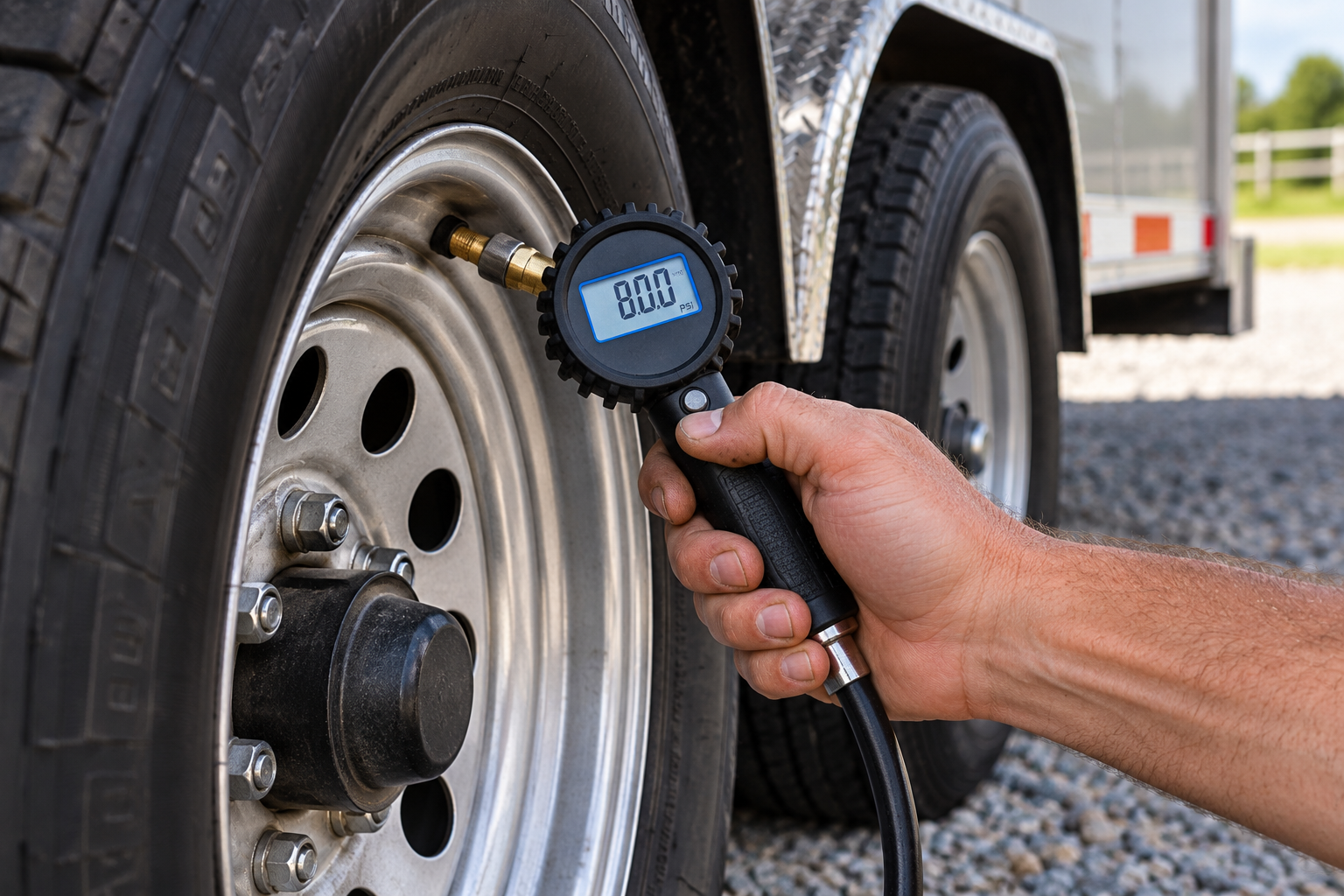
For example, a tire sidewall may state that the tire can carry a certain maximum load when inflated to 80 PSI cold.
That does not mean the tire should never operate above 80 PSI once you’re driving. Tire pressure naturally increases as the tire heats up.
The important number is the cold inflation pressure — the pressure measured before the tire has been driven enough to build significant heat.
Never bleed pressure from a hot tire simply because the pressure has risen above the cold rating.
Should Trailer Tires Always Be Inflated to Maximum PSI?
Not necessarily.
Many trailer applications call for the tire manufacturer’s maximum cold inflation pressure, particularly when the tire needs its full rated load capacity. But maximum pressure isn’t automatically correct for every trailer and every load.
The proper inflation pressure depends on several factors:
- Actual weight carried by the tire
- Tire size
- Tire load range
- Tire manufacturer’s load-and-inflation specifications
- Trailer manufacturer’s recommended pressure
- Wheel pressure rating
If the trailer manufacturer specifies a tire pressure on its certification label or owner’s information, that recommendation should be your starting point when the trailer still has the specified tire size and load rating.
Load Capacity Changes With Tire Pressure
A tire’s maximum load rating assumes a particular inflation pressure.
Reducing pressure can also reduce the amount of weight the tire is designed to carry.
This is one reason simply lowering trailer tire pressure to make the trailer ride softer can be a bad idea.
An underinflated tire carrying a heavy load can flex excessively. That additional flex generates heat, and excessive heat is one of the major enemies of trailer tires.
If you want to run less than the tire’s maximum cold pressure, use the tire manufacturer’s load-and-inflation information rather than guessing.
Know the Actual Weight of Your Trailer
One of the best ways to understand what your tires are actually carrying is to weigh the loaded trailer.
A public truck scale can provide much better information than estimating based on the trailer’s GVWR.
The GVWR is the maximum allowable loaded weight of the trailer, not necessarily what the trailer weighs during normal use.
If a 10,000-pound GVWR trailer normally weighs 7,000 pounds loaded, its tires aren’t necessarily carrying their maximum possible load.
However, total trailer weight alone doesn’t tell the whole story.
Weight may not be distributed evenly from side to side or between axles. Individual tire loads can differ considerably depending on cargo placement.
Don’t Forget Tongue Weight
When a conventional bumper-pull trailer is connected to the tow vehicle, part of the trailer’s weight is carried by the hitch.
That portion is the tongue weight.
For many conventional trailers, tongue weight commonly falls somewhere around 10% to 15% of the loaded trailer weight, although the proper amount depends on the specific trailer and application.
That means the trailer tires normally aren’t supporting the trailer’s entire loaded weight while it’s hitched to the truck.
But don’t use tongue weight as an excuse to run tires with inadequate capacity. Tires should still provide sufficient reserve capacity for the trailer and its expected loading conditions.
Tire Load Range Matters
Trailer tires are available in different load ranges.
Depending on tire size, you may see ratings such as:
- Load Range C
- Load Range D
- Load Range E
- Load Range F
- Load Range G
A higher load range generally allows the tire to carry more weight at its specified inflation pressure, but the exact capacity depends on the particular tire size and design.
Don’t assume every Load Range E tire, for example, has the same capacity or uses the same pressure.
Always read the actual tire specifications.
Make Sure the Wheels Can Handle the Pressure
This is easy to overlook.
Installing a tire capable of running at a higher pressure does not automatically mean the trailer wheel is rated for that pressure.
Before increasing tire pressure beyond the original setup, verify that the wheels, valve stems, and other applicable components are rated appropriately.
A higher-capacity tire cannot safely compensate for a wheel that isn’t designed for the pressure required to achieve that capacity.
Check Tire Pressure When the Tires Are Cold
Trailer tire pressure should normally be checked when the tires are cold.
Ideally, check them before towing for the day.
Driving causes tires to heat up, which increases pressure. Ambient temperature also affects pressure.
Because of this, a pressure reading immediately after a highway trip isn’t directly comparable to a cold-pressure specification.
Set the pressure cold and allow for the normal pressure increase that occurs while towing.
Temperature Changes Matter
Tire pressure changes with ambient temperature.
A trailer that was properly inflated during hot summer weather may be underinflated when temperatures drop significantly.
This is especially important for trailers that sit for long periods between trips.
Check pressure regularly rather than assuming the tires still contain the same pressure they had several weeks or months ago.
Don’t Judge Trailer Tire Pressure by Appearance
Modern trailer tires can look reasonably normal even when they’re significantly underinflated.
A visual inspection is useful for finding obvious problems such as:
- Cracks
- Bulges
- Cuts
- Uneven wear
- Embedded objects
But appearance isn’t a reliable way to determine inflation pressure.
Use an accurate tire-pressure gauge.
Check the Spare Tire Too
The spare tire is one of the easiest trailer maintenance items to forget.
A spare that has been sitting untouched for a year may have lost enough pressure that it isn’t ready when you actually need it.
Check the spare whenever you check the tires on the ground.
Also verify that you have the tools necessary to change a trailer tire safely.
Watch for Uneven Tire Wear
Abnormal wear can provide clues about problems with the trailer.
Possible causes include:
- Incorrect inflation
- Overloading
- Bent axles
- Worn suspension components
- Alignment problems
- Tire imbalance
- Damaged wheels
If one tire is wearing very differently from the others, don’t automatically assume tire pressure is the only cause.
Find the underlying problem.
Tire Pressure Monitoring Systems Can Help
A trailer tire pressure monitoring system can provide useful information while you’re towing.
Depending on the system, it may monitor:
- Tire pressure
- Tire temperature
- Rapid pressure loss
- High-pressure conditions
- High-temperature conditions
A TPMS doesn’t replace regular tire inspections, but it can provide an early warning when something changes while you’re traveling.
That can be especially valuable on multi-axle trailers, where a failing tire may not immediately be obvious from the driver’s seat.
The Bottom Line
The maximum cold PSI printed on a trailer tire is tied to the tire’s rated load capacity, but it isn’t automatically the correct inflation pressure for every trailer in every situation.
Start with the trailer manufacturer’s specifications when using the specified tire setup. Verify the tire’s load-and-inflation requirements, know how much weight the trailer actually carries, and make sure the wheels and valve stems are rated for the pressure you’re using.
Most importantly, don’t guess.
Correct inflation is one of the simplest things you can do to reduce heat buildup, protect your tires, and improve the reliability of your trailer.