Affiliate Disclosure: This article contains affiliate links. If you purchase through these links, TowGearGuide may earn a commission at no additional cost to you.
Choosing a trailer brake controller used to be fairly straightforward: install a controller in the tow vehicle, wire it into the braking system, adjust it for the trailer, and leave it there.
Wireless brake controllers have changed that.
Today, you can use a plug-in wireless controller without permanently mounting a traditional brake controller under the dash. That can be especially appealing if you tow with multiple vehicles, don’t want to modify a newer truck or SUV, or only pull a trailer occasionally.
But convenience isn’t the only thing that matters when you’re controlling several thousand pounds of trailer behind you.
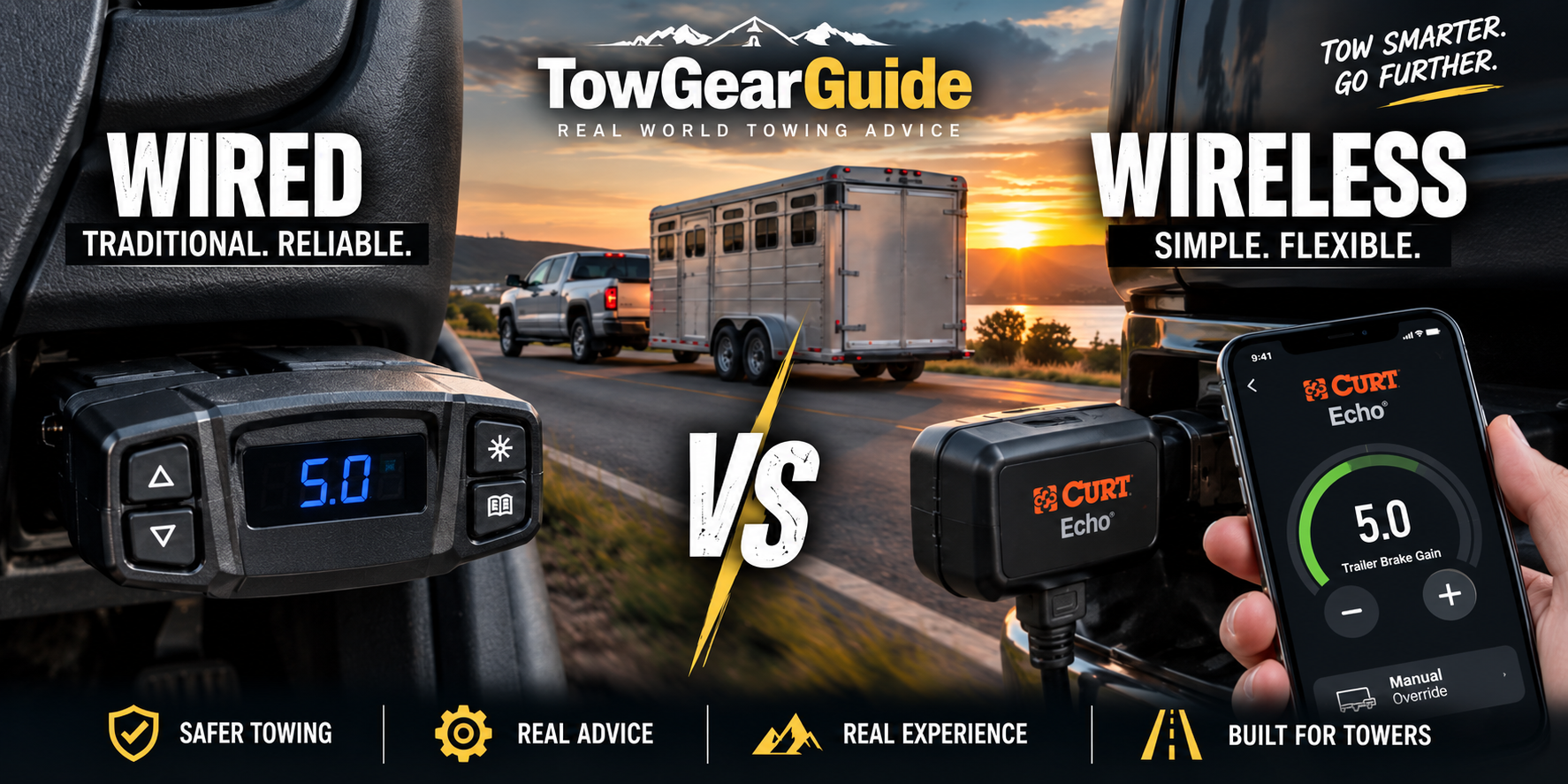
When comparing a wired vs wireless trailer brake controller, which setup is actually better for towing?
For a dedicated tow vehicle that pulls trailers regularly, we generally prefer a quality wired proportional brake controller. For occasional towing, multiple tow vehicles, or situations where permanent installation is inconvenient, a good wireless proportional controller can be an excellent choice.
The right answer depends more on how you tow than on whether one technology is universally “better.”
Wired vs. Wireless Trailer Brake Controller: Quick Answer
| Feature | Wired Brake Controller | Wireless Brake Controller |
|---|---|---|
| Best for | Frequent towing | Occasional/multiple-vehicle towing |
| Installation | Usually requires wiring or a vehicle-specific harness | Often plug-and-play |
| Portability | Usually stays with one vehicle | Easy to move between compatible vehicles |
| Manual control | Usually immediately accessible | Depends on controller design |
| Phone required | No | Some models use a smartphone |
| Clean interior | Depends on installation | No traditional under-dash controller |
| Our preference | Dedicated tow vehicle | Convenience and portability |
There’s an important distinction here: wireless does not automatically mean time-delayed or less sophisticated braking. A wireless controller can still use an accelerometer to provide proportional trailer braking.
The bigger differences are installation, controls, portability, and how the driver interacts with the controller.
How Does a Trailer Brake Controller Work?
A brake controller regulates the electric brakes on a properly equipped trailer.
When the tow vehicle slows, the controller sends power to the trailer’s electric brakes. The amount and timing of that braking force depend on the controller and its settings.
Modern proportional controllers use motion sensing to determine how aggressively the tow vehicle is slowing and apply trailer braking accordingly. A brake controller is only one part of a properly set up towing system. If you’re pulling a heavier trailer, our guide to choosing a weight distribution hitch explains when one may be needed and how to choose the right setup.
If you brake gently approaching a stoplight, the trailer should brake gently. If you brake hard, the controller can command substantially more trailer braking.
That is why we generally favor proportional braking for normal highway towing.
Don’t confuse the question of wired versus wireless with proportional versus time-delayed. They’re different decisions.
What Is a Wired Trailer Brake Controller?
A traditional wired brake controller is installed in the tow vehicle and connected electrically to the vehicle and trailer braking circuits.
Many trucks and SUVs already have provisions for an aftermarket brake controller. Depending on the vehicle, installation may be as simple as connecting the correct vehicle-specific harness. Others require additional wiring.
Advantages of a Wired Brake Controller
Controls are right there when you need them.
This is one of the biggest reasons we like a conventional controller for a truck that tows regularly. With a properly positioned controller, the gain settings and manual trailer-brake control are physically accessible to the driver.
No smartphone is necessary.
Once installed and adjusted, a conventional controller doesn’t depend on your phone as its user interface.
It becomes part of the tow vehicle.
If you use the same truck to tow every week, portability isn’t much of an advantage. Leaving the controller installed means it’s ready whenever the trailer is hooked up.
There are excellent proportional controllers available.
A proven proportional controller can provide smooth braking without making the system unnecessarily complicated.
Disadvantages of a Wired Brake Controller
Installation can take more work.
Some vehicles have plug-in harnesses that make installation easy. Others don’t.
Traditional controllers can take up cabin space.
A box hanging below the dash isn’t everybody’s idea of a clean installation, and poor placement can make it annoying or even uncomfortable.
That problem isn’t universal, though. Controllers such as the REDARC Tow-Pro Elite hide the main control module behind the dash and leave a small control knob accessible to the driver.
They’re less convenient if you constantly switch tow vehicles.
A permanently installed controller makes perfect sense in a dedicated tow rig. It makes less sense if today’s tow vehicle isn’t necessarily tomorrow’s.
What Is a Wireless Trailer Brake Controller?
“Wireless” can describe several designs, but one of the most recognizable examples is the CURT Echo Mobile.
Instead of mounting a conventional controller under the dashboard, the Echo plugs into a compatible 7-way RV blade connection and communicates with a smartphone through Bluetooth.
The controller itself still handles the braking function.
That’s an important distinction because a common concern is:
What happens if the phone dies or Bluetooth disconnects?
According to CURT, after the Echo has been configured it continues operating using the most recently programmed settings if the phone dies or the Bluetooth connection is lost.
However, CURT also states that if Bluetooth is disconnected, the phone-based manual override function is lost.
That difference matters.
Advantages of a Wireless Brake Controller
Installation can be extremely simple.
For somebody with the required functioning 7-way connection, avoiding a conventional in-cab installation is a major attraction.
It’s portable.
A portable controller can make a lot of sense for someone who owns multiple compatible tow vehicles or doesn’t always tow with the same truck.
You don’t have a controller hanging under the dashboard.
There are no knees banging into a traditional controller box and no need to find a good mounting location inside the cab.
It’s attractive for occasional towing.
If you tow a few times a year, permanently installing another device in the vehicle may not be worthwhile.
Disadvantages of a Wireless Brake Controller
The interface may depend more heavily on a phone.
We don’t consider that automatically unsafe, but we do consider it less convenient in some situations.
A phone can be dropped, discharged, locked, buried in a cupholder or running navigation when you want to see something else.
Manual override deserves particular attention.
The trailer-brake manual override is not something we’d want to be hunting for through menus while towing.
CURT offers a separate wireless manual-override button for the Echo Mobile. CURT also notes that its OneControl app must be running in the foreground for that button, because background operation may delay its braking response.
For somebody who tows regularly, a dedicated physical control within easy reach is a meaningful advantage.
Your 7-way connection needs to be right.
Plug-and-play doesn’t mean “works regardless of the vehicle’s wiring.” A wireless plug-in controller still depends on the necessary power, ground and trailer connections.
Wired vs. Wireless Brake Controller: Side-by-Side Comparison
Installation: Wireless Wins
If the vehicle is already compatible, a plug-in wireless controller can eliminate much of the traditional installation work.
That’s particularly valuable on a vehicle you don’t want to modify.
Portability: Wireless Wins
If you regularly change tow vehicles, this isn’t close.
A portable wireless controller is much easier to move than a permanently installed conventional controller.
Everyday Convenience: Wired Wins
For a dedicated tow rig, we prefer getting in, connecting the trailer and having the controller exactly where it always is.
No pairing. No finding the phone. No wondering whether the app is running.
Manual Trailer Braking: Wired Wins
A good wired controller typically gives you a dedicated physical manual control.
That matters because manual trailer braking can be useful in certain towing situations, including helping control trailer sway.
We’d rather have that control immediately accessible than depend on a touchscreen.
Interior Appearance: Depends
A traditional under-dash controller isn’t particularly attractive.
But wired doesn’t necessarily mean a large box hanging below the steering column.
The REDARC Tow-Pro Elite, for example, uses a hidden main module with a dash-mounted remote control. The unit can be installed out of sight while the driver retains a physical control.
Reliability: Both Can Be Good
We wouldn’t claim that a quality wired controller is inherently safe while a quality wireless controller isn’t.
That’s too simplistic.
The more useful question is how many interfaces you want involved in normal operation.
For a truck that spends a lot of time towing, we prefer the simplicity of a permanently installed controller with physical controls.
For somebody who needs portability, the added convenience of wireless may easily outweigh that preference.
Which Is Better for Frequent Towing?
Our pick: wired proportional.
If you’re towing a horse trailer, equipment trailer, travel trailer or other substantial load regularly with the same truck, a quality permanently installed proportional controller makes sense.
It’s always there.
The controls are predictable.
A manual override can be placed within easy reach.
And after the initial installation, there’s very little to think about besides adjusting the controller correctly for the trailer and load.
For this use, we’d look hard at a quality permanently installed proportional controller such as the REDARC Tow-Pro Elite.
Which Is Better for Occasional Towing?
Our pick: wireless has a strong advantage.
Imagine you own an SUV that pulls a camper six weekends a year.
Or maybe you have two vehicles capable of towing the same trailer.
That’s where permanently installing a conventional controller in every vehicle starts making less sense.
A portable controller such as the CURT Echo can be moved between compatible vehicles and trailers, and CURT’s app supports multiple vehicle-trailer profiles.
That’s a legitimate practical advantage—not just a gimmick.
What About Heavy Trailers?
Don’t choose a brake controller for a heavy trailer simply because the box says “wireless” or “wired.” Trailer weight is only part of the setup—proper tongue weight also plays a major role in towing stability. See our guide to trailer tongue weight for recommended percentages and how to measure it.
Look at the controller’s actual specifications, number of supported trailer axles/brakes, braking type, compatibility with the tow vehicle and trailer, and the manufacturer’s installation requirements.
The REDARC Tow-Pro Elite supports proportional braking and a separate user-controlled mode, with REDARC positioning the latter for situations such as off-road towing and steep or loose surfaces. If you’re unsure which trailer weight rating matters, our guide to trailer GVWR vs. GAWR explains the difference and how each rating affects your towing setup.
The larger point is simple:
Match the controller to the trailer and towing conditions. Don’t buy based solely on the connection method.
Two Trailer Brake Controllers Worth Considering
REDARC Tow-Pro Elite — Best Wired Choice
The Tow-Pro Elite takes a different approach.
Its main controller can be mounted out of sight while a small remote control remains accessible on the dash.
It provides proportional braking for normal road use as well as REDARC’s user-controlled mode. REDARC says its three-axis accelerometer allows the main unit to be mounted in different orientations while still sensing deceleration.
The downside is cost and a more involved installation compared with simply plugging a portable controller into a 7-way connector.
But for someone who wants a permanent, factory-looking setup, it’s an appealing design.
Best for: Frequent towing when you want a clean interior installation.
View the REDARC Tow-Pro Elite on Amazon
CURT Echo Mobile — Best Wireless Choice
The Echo’s strongest feature isn’t that it uses Bluetooth.
It’s that you can avoid installing a traditional controller in the vehicle.
It plugs into a compatible 7-way RV blade connector and uses an internal accelerometer for proportional braking. CURT says the controller retains its last programmed braking settings if the phone dies or Bluetooth disconnects.
It can also be transferred between compatible vehicles, which makes it particularly interesting for occasional towing.
We would consider adding CURT’s physical manual-override button if we planned to use the Echo regularly.
Best for: Occasional towing, multiple compatible tow vehicles and people who don’t want a permanent in-cab controller.
View the CURT Echo Mobile on Amazon
Our Verdict: Wired or Wireless?
Neither design wins every category.
If we were setting up a truck that would pull the same horse trailer, equipment trailer or camper regularly, we’d install a good wired proportional controller and leave it there.
The convenience of having a dedicated controller and physical controls outweighs the portability advantage of wireless when the controller rarely needs to move.
But if we were towing occasionally, switching between vehicles, or didn’t want to permanently install a controller, we’d seriously consider a quality wireless proportional controller.
That’s the real distinction:
Frequent towing with one vehicle → wired proportional controller.
Occasional towing or multiple vehicles → wireless becomes much more attractive.
Don’t choose based on which technology sounds newer. Choose based on the way you actually tow.
Frequently Asked Questions
Are wireless trailer brake controllers reliable?
A quality wireless controller can provide proportional trailer braking just like a conventional controller. Reliability and functionality depend on the particular controller and installation, so check the manufacturer’s specifications rather than assuming all wireless controllers operate the same way.
What happens if Bluetooth disconnects from a CURT Echo?
CURT states that the Echo Mobile continues braking using its most recently programmed settings if Bluetooth is lost or the phone dies. The phone-based manual override is unavailable while Bluetooth is disconnected.
Is a wired trailer brake controller safer?
We wouldn’t make that blanket claim. Both wired and wireless controllers can provide proportional braking. For frequent towing, however, we prefer a permanent controller with easily accessible physical controls because of its simplicity and immediate manual control.
Does a wireless brake controller need a phone?
It depends on the controller. The CURT Echo Mobile uses a smartphone as its primary interface for configuration and control, although the controller itself continues operating at its stored setting if the phone connection is lost.
Can I move a wireless brake controller between vehicles?
Some are specifically designed for this. CURT describes the Echo Mobile as portable between compatible vehicles and trailers equipped with the required 7-way RV blade connection.
Do I need a brake controller if my truck has a tow package?
Not necessarily. A tow package may include the wiring needed for a brake controller without including the controller itself. Some newer trucks have an integrated factory trailer brake controller. Check the equipment actually installed on your specific vehicle rather than assuming a tow package includes one.
Can I use a brake controller with electric-over-hydraulic trailer brakes?
Some brake controllers support electric-over-hydraulic braking while others may not. Always verify that the specific controller is compatible with your trailer’s braking system before purchasing or installing it.
Bottom Line
For most people who tow frequently with one dedicated vehicle, a wired proportional brake controller remains our first choice.
For occasional towing or anyone who regularly changes tow vehicles, wireless offers convenience that a permanent controller simply can’t match.
Whichever route you choose, buy a controller that’s properly rated and compatible with your trailer, install it according to the manufacturer’s instructions, and take the time to adjust the braking correctly before hitting the highway.
A brake controller isn’t the place to choose equipment based on convenience alone. It’s part of the system responsible for stopping everything you’re towing.
1 thought on “Wireless vs. Wired Trailer Brake Controllers: Which Is Better for Towing?”
Comments are closed.