GVWR and GAWR are two of the most important ratings on a trailer, but they are often misunderstood. GVWR tells you the maximum allowable weight of the fully loaded trailer, while GAWR tells you the maximum weight that a particular axle—or axle system—is rated to carry. Understanding the difference matters when choosing tires, loading a trailer, replacing axles or suspension components, and determining how much weight a trailer can safely handle.
What Is GVWR?
GVWR stands for Gross Vehicle Weight Rating. On a trailer, it is the maximum allowable weight of the trailer when fully loaded. That includes the empty trailer itself plus cargo, equipment, water, supplies, animals, or anything else being carried.
For example, if a trailer has a GVWR of 9,995 pounds, the trailer and everything loaded in or on it must remain within that rating. Installing heavier-duty tires, wheels, springs, or axles does not automatically increase the manufacturer’s GVWR.
What Is GAWR?
GAWR stands for Gross Axle Weight Rating. It is the maximum allowable weight that can be carried by a particular axle or axle system, as specified for the trailer. A tandem-axle trailer may have two axles with the same individual rating, but that does not necessarily mean you can simply add those ratings together and call the result the trailer’s GVWR.
The trailer’s overall rating can also be limited by its frame, suspension, tires, wheels, coupler, brakes, or other components. The manufacturer’s GVWR remains the rating for the complete trailer even when individual components are capable of carrying more weight.
Why GVWR and Axle Ratings Don’t Always Match
It’s common to see a trailer whose axle ratings don’t appear to match its GVWR exactly. For example, a tandem-axle trailer might use two 5,200-pound axles, giving the axles a combined nominal rating of 10,400 pounds, while the trailer itself has a GVWR of 9,995 pounds.
That does not make the trailer a 10,400-pound-GVWR trailer. The manufacturer’s stated GVWR is the rating that applies to the complete trailer. Component ratings tell you what individual parts are designed to handle; they don’t automatically redefine the rating of the finished trailer.
Some of the trailer’s loaded weight is also transferred to the tow vehicle through the tongue or gooseneck. This is one reason you shouldn’t try to determine a trailer’s allowable loaded weight simply by adding together the ratings printed on its axles.
GVWR vs. Payload Capacity
GVWR is not the same thing as payload capacity. Payload is the amount of weight the trailer can carry after accounting for the empty weight of the trailer. A simple starting calculation is to subtract the trailer’s empty weight from its GVWR.
For example, if a trailer has a 9,995-pound GVWR and weighs 3,500 pounds empty, the difference is 6,495 pounds. But treat that as a starting point rather than assuming you can load exactly that amount. Permanently installed equipment, modifications, accessories, fluids, and other added weight can reduce the cargo capacity available to you. Weighing the loaded trailer is the best way to know what it actually weighs.
How Tongue Weight Fits Into the Picture
Not all of a trailer’s weight rests on its axles. A portion of the loaded trailer weight is carried by the tow vehicle through the hitch. On a conventional bumper-pull trailer, this is generally called tongue weight. On a gooseneck or fifth-wheel trailer, the load transferred to the tow vehicle is commonly referred to as pin or hitch weight.
That transferred weight still counts as part of the trailer’s total loaded weight when comparing it with the trailer’s GVWR. It also adds load to the tow vehicle, so the truck’s payload, axle ratings, hitch rating, and other limits need to be considered separately. Moving cargo around can change tongue or pin weight without changing the trailer’s total weight.
Why Tire Ratings Matter
The tires must be capable of supporting the loads placed on them, but tire capacity does not determine the trailer’s GVWR. Installing tires with a higher load capacity can provide an appropriate capacity margin when they are compatible with the trailer, but it does not increase the ratings of the axles, wheels, suspension, frame, brakes, or trailer itself.
Check the load rating of the exact tire size and model being used, along with its required inflation pressure. The wheels and valve stems also need to be suitable for the load and pressure involved. This is why tire selection should be considered as part of the complete trailer system rather than as an isolated upgrade.
Can You Increase a Trailer’s GVWR by Upgrading Parts?
Replacing a trailer’s axles, springs, tires, wheels, or brakes with higher-rated components does not by itself change the manufacturer’s GVWR. Those upgrades may improve durability or replace components with appropriate capacity, but the trailer’s official rating applies to the complete vehicle as manufactured and rated.
If you need substantially more carrying capacity than the trailer is rated for, the proper solution is generally a trailer designed and rated for the heavier load—not simply upgrading a few components and assuming the trailer can legally or safely carry more weight.
How to Find Your Trailer’s Ratings
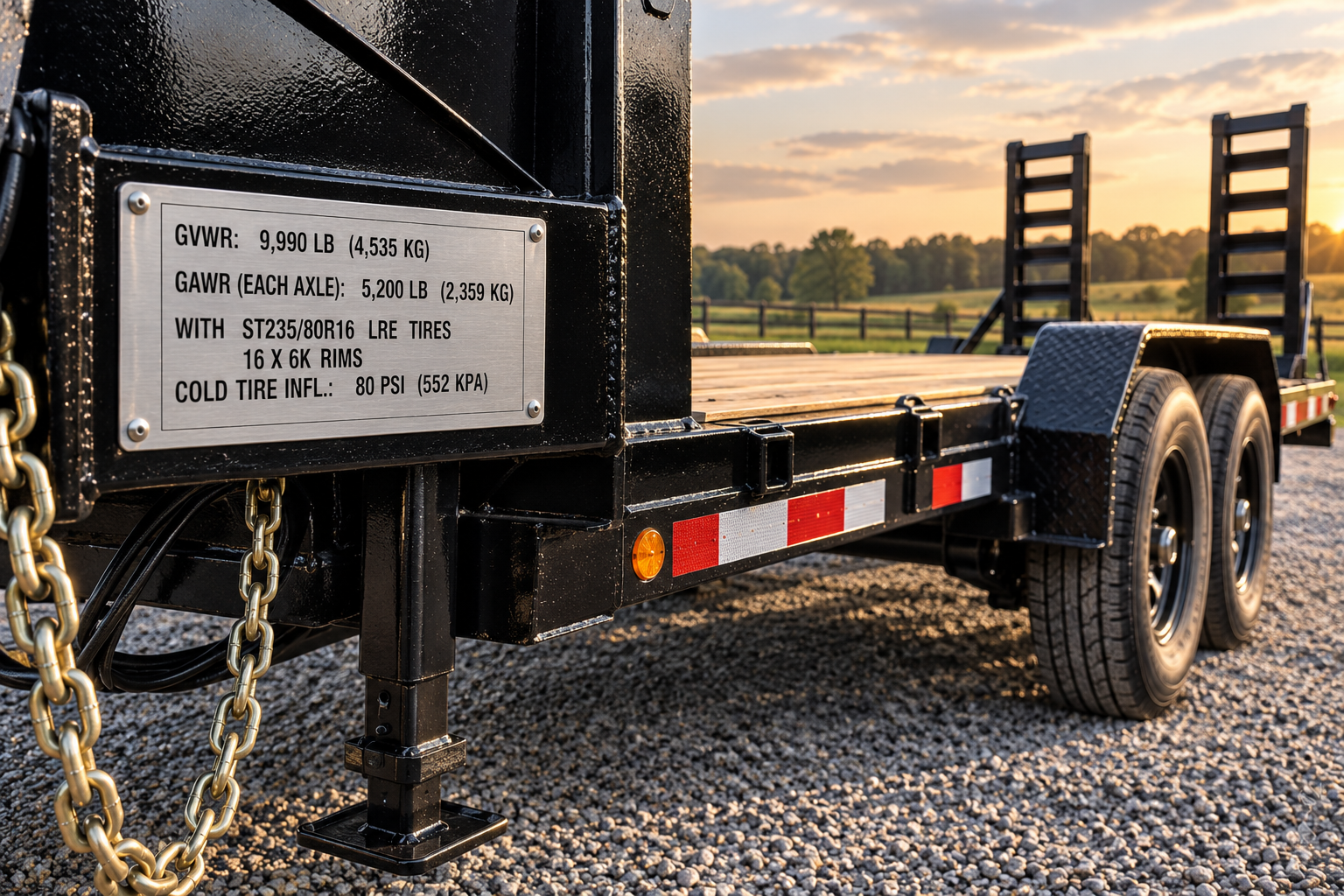
Start with the trailer’s certification or identification label, which is commonly attached to the frame or body of the trailer. Depending on the trailer, the label may list information such as GVWR, GAWR, VIN, tire size, rim size, and recommended tire inflation pressure.
Don’t rely solely on the ratings stamped on replacement axles, tires, or wheels to determine the trailer’s overall capacity. Components may have been replaced during the trailer’s life. When information is missing or unclear, use the trailer manufacturer’s documentation when available and verify the actual loaded weight on a suitable vehicle scale.
Common GVWR and GAWR Mistakes
Adding the axle ratings together and assuming that’s the trailer’s GVWR. The manufacturer’s stated GVWR applies to the complete trailer.
Assuming heavier tires increase trailer capacity. Higher-rated tires don’t increase the ratings of the frame, axles, suspension, wheels, brakes, or coupler.
Confusing GVWR with payload. GVWR includes the trailer itself as well as its cargo.
Forgetting about added equipment. Toolboxes, spare tires, flooring, tanks, batteries, racks, and other permanent additions reduce the remaining cargo capacity.
Ignoring the tow vehicle. A properly loaded trailer can still overload the truck’s payload, axle, tire, or hitch ratings.
Guessing instead of weighing. A suitable vehicle scale can tell you what the loaded combination actually weighs.
The Bottom Line
GVWR tells you the maximum allowable loaded weight of the complete trailer, while GAWR tells you how much weight the axle or axle system is rated to carry. Neither number should be considered by itself. Tires, wheels, suspension, brakes, hitch components, the trailer structure, load distribution, and the tow vehicle all have limits that matter.
When you’re unsure how much your trailer actually weighs, load it as you normally use it and weigh it on a suitable vehicle scale. Knowing the real numbers is far better than estimating—and it gives you a solid basis for choosing tires, equipment, and a tow vehicle that are appropriate for the job.