Affiliate Disclosure: This article contains affiliate links. If you purchase through these links, TowGearGuide may earn a commission at no additional cost to you.
Why Tongue Weight Matters
Trailer tongue weight is one of the most important—and often misunderstood—parts of towing a trailer. It is the downward force the trailer applies to the hitch ball or other hitch connection on the tow vehicle. Having the right amount of tongue weight helps keep the trailer stable and predictable.
Too little tongue weight can contribute to trailer sway and instability. Too much can overload the tow vehicle’s hitch, rear axle, suspension, or available payload.
The goal isn’t simply to make the front or rear of the trailer heavier. The goal is to properly load the trailer while staying within every applicable weight rating.
What Is Tongue Weight?
Tongue weight is the portion of the trailer’s actual loaded weight that presses downward on the hitch. For conventional bumper-pull trailers, a commonly used starting guideline is approximately 10% to 15% of the loaded trailer weight, although the correct range can vary depending on the trailer design and manufacturer recommendations. For example, if a conventional trailer weighs 6,000 pounds when loaded, a 10% to 15% range would equal approximately 600 to 900 pounds of tongue weight. That is only a general example. Always follow the recommendations and ratings for the particular trailer, hitch, and tow vehicle.
Tongue Weight Is Based on the Loaded Trailer
One common mistake is calculating tongue weight from the trailer’s empty or advertised weight. What matters when you’re towing is the trailer’s actual loaded weight. Cargo, equipment, water, batteries, propane cylinders, spare tires, tools, horses, vehicles, or anything else added to the trailer can change both total trailer weight and tongue weight. Where that weight is positioned matters too.
Why Too Little Tongue Weight Can Be Dangerous
A trailer with insufficient tongue weight may be more prone to sway. If too much weight is concentrated toward the rear of the trailer, the trailer can become less stable as speed increases. Sway can begin as a relatively small side-to-side movement and, under the wrong conditions, become severe. Wind, passing trucks, steering inputs, road conditions, speed, and improper loading can all contribute, but correct trailer loading and adequate tongue weight are fundamental parts of a stable towing setup.
What Happens With Too Much Tongue Weight?
More tongue weight isn’t always better. Excessive tongue weight can place too much load on the rear of the tow vehicle. That can reduce available payload, overload the rear axle or tires, exceed the receiver or hitch rating, and alter the tow vehicle’s handling. Depending on the vehicle and suspension design, excessive rear loading can also reduce weight carried by the front axle, which may affect steering and braking characteristics. Every part of the towing combination needs to remain within its rating.
Tongue Weight Counts Against Tow-Vehicle Payload
This is one of the most important towing calculations to understand. The trailer’s tongue weight becomes load carried by the tow vehicle. That means it uses some of the truck or SUV’s available payload capacity. Passengers, tools, cargo, aftermarket equipment, a bed-mounted toolbox, fuel or other items as applicable, and the hitch equipment itself can also contribute to the vehicle’s loaded weight. A vehicle can therefore be within its advertised maximum trailer-towing capacity while still exceeding another important rating.
Towing Capacity and Payload Are Not the Same Thing
Manufacturers often advertise a maximum towing capacity, but that number alone doesn’t determine whether a particular trailer combination is within all limits.
You also need to consider ratings such as:
- GVWR — Gross Vehicle Weight Rating
- GAWR — Gross Axle Weight Rating
- GCWR — Gross Combined Weight Rating, when specified
- Receiver or hitch ratings
- Tire and wheel ratings
- Actual loaded vehicle weight
- Actual loaded trailer weight
- Tongue weight
The lowest applicable limit is the one that matters.
Check the Hitch and Receiver Ratings
The receiver attached to the tow vehicle has its own ratings. Depending on the equipment, it may list separate ratings for weight-carrying and weight-distribution operation. The ball mount and hitch ball also have ratings. A heavy-duty receiver does not increase the ratings of a weaker ball mount, hitch ball, tow vehicle, or trailer component. The complete system must be appropriate for the load. Tongue weight is only one part of a properly matched towing setup. See our guide to choosing a trailer hitch, receiver class, and weight rating.
How Cargo Position Changes Tongue Weight
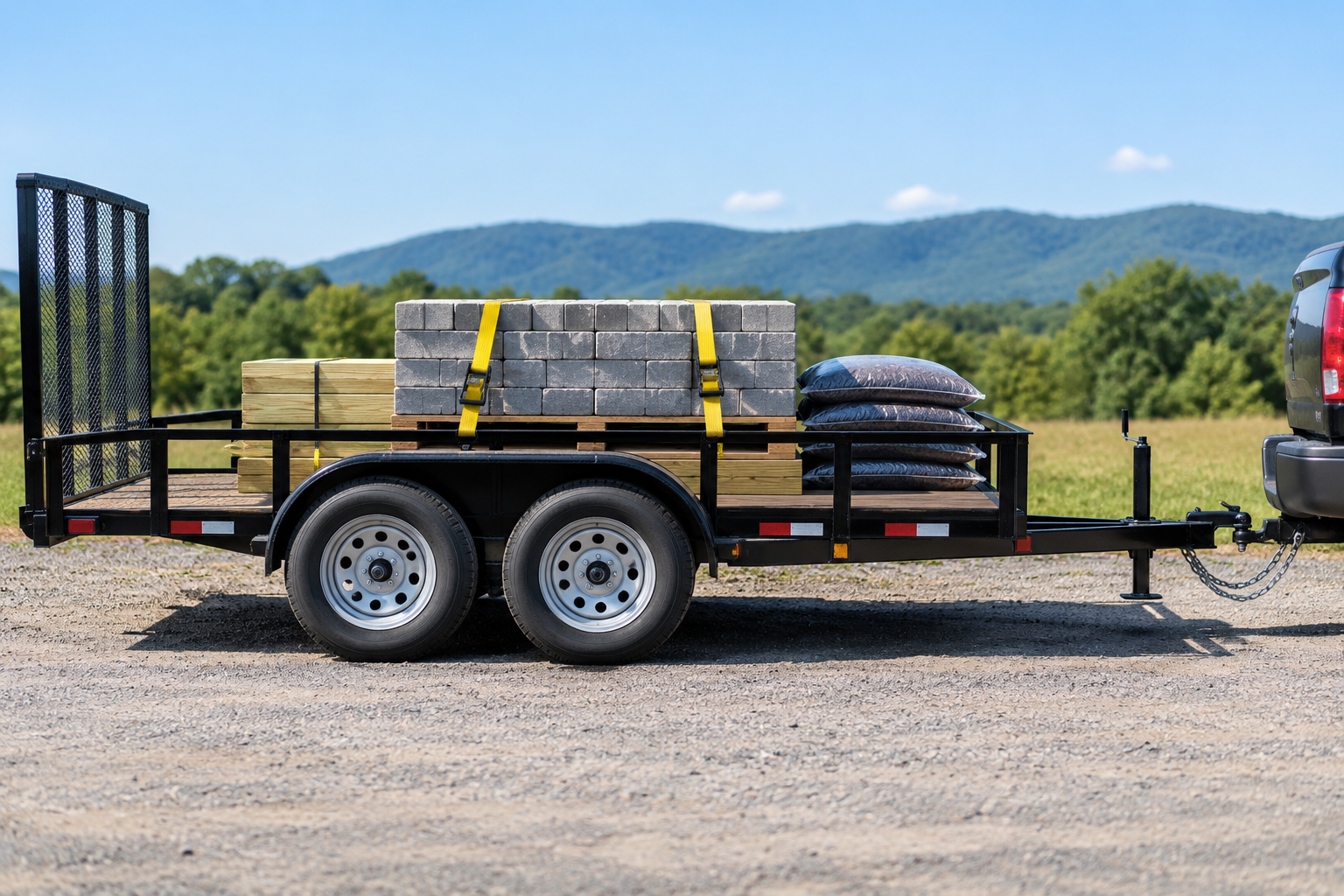
Moving cargo forward generally increases tongue weight. Moving cargo rearward generally decreases tongue weight. But cargo placement isn’t just about achieving a percentage. Cargo should also be secured properly, positioned according to the trailer manufacturer’s instructions, and arranged so that individual axles, tires, and other components are not overloaded. Heavy cargo placed far behind the trailer axles can substantially reduce tongue weight and may negatively affect stability.
Trailer Axle Position Matters
Trailer design has a major influence on tongue weight. The position of the axle or axle group relative to the trailer’s center of mass helps determine how much load is carried at the tongue. This is one reason you can’t assume that two trailers with the same total weight will have identical tongue weight. Trailer geometry and cargo distribution both matter.
How to Measure Tongue Weight
For lighter trailers, a purpose-built tongue-weight scale may provide a convenient measurement when used according to its instructions. For heavier towing combinations, certified vehicle scales can provide much more useful information about the complete setup. A scale can help determine actual tow-vehicle axle weights and trailer axle weight. With appropriate weighing procedures, those measurements can also help determine how much load the trailer is transferring to the tow vehicle. The important point is to measure rather than guess when accurate loading information matters.
Recommended Tongue Weight Scale: The Sherline LM 2000 Trailer Tongue Weight Scale is a purpose-built way to measure trailer tongue weight, with a gauge rated from 0–2,000 pounds. It can be positioned under the trailer’s ball receiver or jack to get a direct tongue-weight measurement, helping take the guesswork out of trailer loading. Check the Sherline LM 2000 Trailer Tongue Weight Scale on Amazon.
A Useful Scale-Weighing Approach
Depending on the towing setup and scale facility, you may be able to compare weights with the trailer connected and disconnected to understand how the trailer affects the tow vehicle. For a weight-distribution hitch, additional measurements may be useful because the hitch changes how load is distributed among the tow vehicle’s axles and the trailer axles. Follow the hitch manufacturer’s setup procedure rather than attempting to tune a weight-distribution system using tongue-weight percentage alone.
What Does a Weight-Distribution Hitch Do?
A weight-distribution hitch uses spring bars or another mechanical arrangement to redistribute some of the load imposed at the hitch connection. It can help restore appropriate loading to the tow vehicle’s front axle and improve the overall towing setup when properly specified and adjusted. However, a weight-distribution hitch does not make excessive trailer weight disappear. It also does not automatically increase the tow vehicle’s GVWR, axle ratings, tire ratings, or other manufacturer-established limits.
Tongue Weight and Trailer Sway
Correct tongue weight is an important part of sway prevention, but it isn’t the only factor. Tire condition and inflation, vehicle loading, trailer loading, suspension condition, hitch setup, speed, wind, road conditions, and trailer design can all influence stability. Sway-control equipment can be useful for appropriate applications, but it should not be used as a substitute for correcting an improperly loaded trailer. If a trailer has dangerously low tongue weight, the loading problem should be corrected.
Horse and Livestock Trailers Require Special Attention
Live cargo creates additional considerations because animals can move while the trailer is traveling. A horse or livestock trailer should be loaded according to the trailer manufacturer’s recommendations, and the towing combination should have adequate capacity for the trailer, animals, tack, feed, equipment, and other cargo. Do not assume that an empty trailer’s tongue-weight percentage will remain the same after animals and equipment are loaded. Actual loaded weights provide much better information.
Equipment and Utility Trailers
Equipment trailers can experience major changes in tongue weight depending on where machinery is positioned. Moving a tractor, skid steer, mower, vehicle, or other heavy machine only a relatively short distance can significantly change the load carried by the tongue and trailer axles. Position equipment according to the trailer and equipment manufacturers’ guidance, secure it correctly, and verify actual weights when necessary.
Common Tongue Weight Mistakes
Using empty trailer weight for the calculation. Tongue weight should reflect the trailer as it is actually loaded for travel.
Loading heavy cargo too far rearward. This can reduce tongue weight and contribute to instability.
Assuming more tongue weight is always safer. Excessive tongue weight can overload the tow vehicle or hitch.
Ignoring payload. Tongue weight becomes part of the load carried by the tow vehicle.
Looking only at advertised towing capacity. Axle, vehicle, hitch, tire, and combined-weight ratings also matter.
Assuming a weight-distribution hitch increases every rating. It changes load distribution; it does not erase manufacturer limits.
Guessing instead of weighing. A scale can reveal loading problems that aren’t obvious by looking at the vehicle.
A Practical Example
Suppose a conventional trailer weighs 8,000 pounds when fully loaded. Using the general 10% to 15% guideline would suggest roughly 800 to 1,200 pounds of tongue weight as a starting reference. But that doesn’t automatically mean the tow vehicle can handle 1,200 pounds of tongue weight. You still need to determine whether the vehicle has enough available payload after accounting for passengers, cargo and hitch equipment, and whether the receiver, rear axle, tires, wheels, and other components remain within their ratings. This is why towing capacity alone doesn’t tell the whole story. Tongue weight must also be considered alongside the trailer’s overall weight ratings. See our guide explaining trailer GVWR vs. GAWR and what those ratings mean.
The Bottom Line
For many conventional trailers, approximately 10% to 15% of actual loaded trailer weight is a commonly used tongue-weight guideline, but the correct setup ultimately depends on the trailer manufacturer’s recommendations and the ratings of the complete towing combination. Too little tongue weight can contribute to instability. Too much can overload the tow vehicle or hitch. Know the trailer’s actual loaded weight, understand how tongue weight affects tow-vehicle payload, check every applicable rating, load cargo appropriately, and use actual scale measurements when possible. A properly loaded trailer is not just easier to tow—it is a fundamental part of a stable towing setup.
3 thoughts on “Tongue Weight Explained: How Much Does Your Trailer Need?”
Comments are closed.