Affiliate Disclosure: This article contains affiliate links. If you purchase through these links, TowGearGuide may earn a commission at no additional cost to you.
Towing a heavy trailer can place a significant amount of weight on the rear of a truck or SUV. As tongue weight pushes down behind the rear axle, the rear suspension compresses and some load can be removed from the front axle. A properly selected and adjusted weight distribution hitch can help redistribute that load and improve the way the tow vehicle and trailer work together.
But a weight distribution hitch is often misunderstood. It does not increase your truck’s GVWR, GAWR, payload rating, receiver rating, or maximum towing capacity. It also cannot correct an overloaded trailer or poor loading. The key is knowing when a weight distribution hitch is appropriate, how it works, and how to choose one that matches your actual towing setup.
What Is a Weight Distribution Hitch?
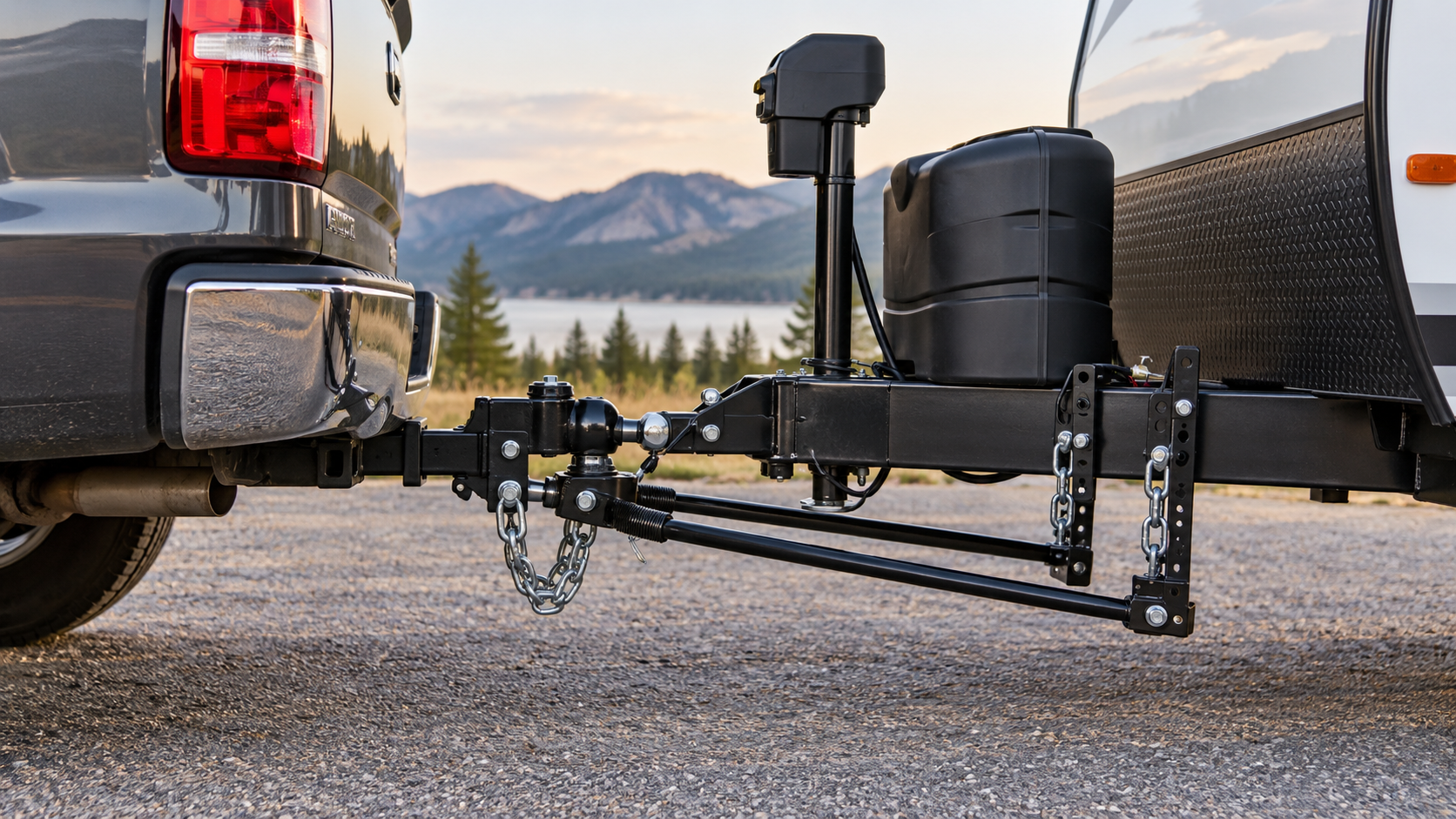
A weight distribution hitch, often shortened to WDH, is a hitch system that uses spring bars to create leverage between the tow vehicle and trailer. With a conventional ball mount, the trailer’s tongue weight is applied behind the tow vehicle’s rear axle. Think of the rear axle somewhat like the pivot point of a lever. As the tongue pushes downward behind that pivot, the rear suspension compresses and load can be removed from the front axle.
A weight distribution hitch uses spring bars to counteract part of that effect. When properly adjusted, the system redistributes some of the load that would otherwise be concentrated at the tow vehicle’s rear axle. This can restore appropriate loading toward the front axle while also transferring some load through the trailer.
The goal isn’t simply to make the truck look level. The more important goal is proper load distribution while staying within the ratings of the tow vehicle, hitch, trailer, axles, tires, wheels, and other components.
Why Front-Axle Load Matters
Rear suspension squat is easy to see, but the effect at the front of the tow vehicle is often more important. When substantial tongue weight is applied behind the rear axle, the front suspension may rise as some load comes off the front axle. That can affect how the vehicle responds because the front tires are responsible for much of the steering and braking.
This is why judging a towing setup only by how much the rear bumper drops can be misleading. Manufacturers of weight distribution systems commonly use measurements at the front wheel opening—or other vehicle-specific procedures—to determine whether the proper amount of front-axle loading has been restored. Always use the procedure specified by the tow vehicle and hitch manufacturers for your particular combination.
When Do You Need a Weight Distribution Hitch?
There is no single trailer-weight number that determines whether every vehicle needs a weight distribution hitch. One truck may require or recommend weight distribution at a particular trailer weight while another may not. Receiver ratings can also differ between weight-carrying and weight-distributing configurations.
The correct place to start is the owner’s manual and towing information for the tow vehicle, followed by the ratings and instructions for the receiver and hitch. A weight distribution hitch may be appropriate when:
- The vehicle manufacturer requires or recommends one for the trailer being towed.
- The receiver is rated for the trailer only when used in weight-distributing mode.
- Tongue weight causes significant unloading of the tow vehicle’s front axle.
- The towing combination falls within the operating range of a properly sized weight distribution system.
Never assume that adding a weight distribution hitch makes an overloaded towing combination acceptable. For an example of manufacturer-specific guidance, see the Chevrolet Trailering Guide.
Weight Distribution Does Not Increase Your Truck’s Ratings
This is one of the most important points to understand. Installing a weight distribution hitch does not increase the manufacturer’s ratings for the truck or trailer.
You still must stay within all applicable limits, including:
- Gross Vehicle Weight Rating (GVWR)
- Gross Axle Weight Ratings (GAWR)
- Payload capacity
- Gross Combined Weight Rating (GCWR), when applicable
- Maximum trailer weight
- Receiver and hitch ratings
- Trailer GVWR and axle ratings
- Tire and wheel load ratings
The lowest applicable rating is still the limiting factor. For a more detailed explanation of these ratings, see our guide to Trailer GVWR vs. GAWR.
Start With Loaded Tongue Weight
Choosing a weight distribution hitch should be based on the trailer as it will actually be used, not simply the empty weight printed in a brochure. Tongue weight changes when you add cargo, water, batteries, propane, tools, camping equipment, horses, equipment, or other loads. Where that weight is placed matters too.
For many conventional trailers, loaded tongue weight commonly falls somewhere around 10% to 15% of loaded trailer weight, although the correct range can depend on the trailer and manufacturer. If you haven’t already, read our guide to Trailer Tongue Weight Explained for a deeper look at measuring and managing tongue weight.
Whenever practical, measure the trailer after it has been loaded as it will normally travel.
How to Choose the Right Weight Distribution Hitch Size
Weight distribution systems are normally offered in different trailer-weight and tongue-weight capacities. The biggest hitch is not automatically the best hitch. The system needs enough capacity for the loaded trailer and tongue weight while still operating within the manufacturer’s intended range.
For example, imagine a trailer that weighs 7,000 pounds when loaded and has 850 pounds of measured tongue weight. A weight distribution system whose maximum tongue-weight rating is below 850 pounds would be undersized for that condition.
At the same time, simply jumping to an extremely stiff system designed for far greater tongue weights isn’t necessarily the right solution. Spring-bar capacity should match the actual application and the hitch manufacturer’s sizing recommendations. Some manufacturers also instruct owners to consider cargo carried in the tow vehicle behind the rear axle when determining the appropriate system size.
Always follow the sizing method specified by the manufacturer of the particular weight distribution system you’re considering. One example is the CURT TruTrack 4P #17500, a weight distribution hitch with integrated sway control rated by CURT for up to 10,000 pounds of gross trailer weight and 1,000 pounds of tongue weight. Those ratings make it one option for trailers that fall within its specified range, but buyers should verify their actual loaded tongue weight and all applicable vehicle and hitch ratings before choosing this or any weight distribution system.
Don’t Size a Hitch From Dry Tongue Weight Alone
Trailer brochures often list an unloaded or “dry” tongue weight. That number can be useful for comparing trailers, but it may be very different from the tongue weight when you’re ready to travel.
Consider what may be added near the front of a trailer:
- Propane cylinders
- Batteries
- Water
- Tools
- Spare equipment
- Camping gear
- Cargo
- Trailer accessories
Even cargo placed farther back can change tongue weight by altering the trailer’s balance. A hitch selected only from the empty trailer specification may therefore be incorrectly sized once the trailer is loaded.
Weight Distribution vs. Sway Control
Weight distribution and sway control are related, but they are not the same thing. Weight distribution addresses how tongue load affects the tow vehicle and trailer axles. Sway control is intended to resist or reduce unwanted side-to-side trailer movement.
Some modern weight distribution hitches incorporate sway-control features into the hitch design. Other systems use separate sway-control components. A weight distribution hitch should not be viewed as a cure for a trailer that is inherently unstable.
Trailer sway can be influenced by several factors, including insufficient tongue weight, improper cargo placement, excessive speed, tire problems, trailer alignment or suspension problems, wind and aerodynamic forces, and an improperly matched tow vehicle and trailer. If a trailer is unstable, find the underlying cause rather than depending on the hitch to hide it.
Weight Distribution Hitch vs. Air Bags
Air springs, commonly called air bags, and weight distribution hitches perform different jobs. Air bags support the tow vehicle’s suspension and can help control rear ride height under load. A weight distribution hitch uses leverage through its spring bars to change how hitch load affects the tow vehicle and trailer.
Inflating air bags may make a truck sit level, but appearance alone does not tell you whether front-axle loading has been properly restored. If your truck has air suspension, helper springs, or aftermarket air bags, follow the instructions from both the vehicle and hitch manufacturers when setting up weight distribution. The order in which suspension systems are adjusted can affect the final hitch setup.
Receiver Ratings Matter
Check the label or documentation for the receiver hitch on the tow vehicle. Some receivers specify separate ratings for Weight Carrying (WC), which is conventional ball-mount operation without a weight distribution system, and Weight Distributing (WD), which is operation with an approved weight distribution system.
Do not assume the higher number automatically applies just because a weight distribution hitch has been installed. The receiver must be designed and rated for weight distribution, and every other applicable vehicle and trailer rating still applies.
Our How to Choose a Trailer Hitch guide explains receiver classes and hitch ratings in more detail.
Proper Setup Is Just as Important as Proper Size
Buying the correct hitch is only half the job. A poorly adjusted weight distribution hitch may not perform as intended. Although procedures vary by manufacturer, setup commonly involves:
- Loading the tow vehicle and trailer as they will normally travel.
- Parking the combination on level ground.
- Establishing baseline vehicle measurements.
- Setting hitch-ball height and hitch-head position.
- Installing and engaging the spring bars.
- Measuring the tow vehicle again with the system engaged.
- Adjusting spring-bar tension or hitch-head angle according to the manufacturer’s instructions.
- Tightening hardware to the specified torque.
- Rechecking the setup after loading changes and as required by the manufacturer.
Do not substitute a generic internet measurement for the procedure supplied with your specific hitch and tow vehicle.
Common Weight Distribution Hitch Mistakes
Buying Based Only on Trailer GVWR
GVWR tells you the trailer’s maximum rated loaded weight. It does not tell you the trailer’s actual loaded tongue weight. Both numbers matter when selecting a hitch.
Using the Dry Tongue Weight
The actual travel-ready tongue weight may be substantially different after the trailer is loaded.
Buying the Highest-Capacity Spring Bars Available
More capacity isn’t automatically better. The system should be appropriately matched to the load and manufacturer’s specifications.
Trying to Fix an Overloaded Truck
A weight distribution hitch cannot create additional payload, axle capacity, tire capacity, or GVWR.
Adjusting the Hitch Just to Eliminate Rear Squat
Vehicle stance is only part of the picture. Proper front-axle loading and manufacturer-specified measurements matter more than appearance alone.
Ignoring Receiver Ratings
The receiver itself must be approved for the trailer weight, tongue weight, and weight-distribution use.
Assuming Weight Distribution Eliminates Sway
Proper weight distribution can contribute to a stable towing combination, but it cannot compensate for poor trailer loading or other causes of instability.
A Realistic Example
Consider a pickup towing a travel trailer that weighs 7,000 pounds fully loaded. After loading the trailer for a trip, suppose the measured tongue weight is 850 pounds.
Before choosing a weight distribution hitch, the owner should verify:
- The truck is rated to tow the loaded trailer.
- Available payload can accommodate the trailer’s effect on the truck along with passengers and cargo.
- Front and rear axle loads remain within GAWR.
- The receiver is rated for the application and for weight-distribution use.
- Tires and wheels are within their load ratings.
- The trailer itself remains within GVWR and axle ratings.
- The proposed weight distribution system is rated appropriately for both loaded trailer weight and tongue weight.
Only after those checks does choosing and adjusting the WDH make sense. This approach is much safer than simply saying, “It’s a 7,000-pound trailer, so buy a 10,000-pound hitch.”
Should You Weigh Your Setup?
For heavier towing, an actual scale can remove much of the guesswork. A public vehicle scale can help determine loaded truck and trailer weights and, with appropriate separate axle measurements, show how the load is distributed. A tongue-weight scale can also help measure the downward load at the coupler.
Scale readings don’t change the manufacturer’s ratings. They tell you what the combination actually weighs so you can compare those numbers with the applicable ratings.
Recheck the Hitch When Your Load Changes
A weight distribution hitch isn’t necessarily a set-it-once-and-forget-it component. Significant changes in trailer loading can change tongue weight and therefore affect hitch adjustment. Filling or emptying water tanks, adding batteries or propane, carrying different equipment, moving heavy cargo, changing tow vehicles, or making major suspension changes can all affect the setup.
Periodically inspect the hitch components and mounting hardware as directed by the manufacturer, and recheck adjustment when the towing configuration changes substantially.
The Bottom Line
A weight distribution hitch can be an important part of a properly matched towing setup, but it is not a way to increase the ratings of your truck or trailer. Start with the actual loaded trailer and tongue weight. Verify the ratings of the tow vehicle, receiver, trailer, axles, tires, and wheels. Then select a weight distribution system that fits the application and adjust it according to the manufacturers’ instructions.
The right system should be chosen based on real weights and real ratings—not simply by buying the largest hitch on the shelf. When the tow vehicle, trailer, loading, and hitch are all properly matched, weight distribution can help the entire combination behave more predictably on the road.
1 thought on “Weight Distribution Hitch Explained: When You Need One and How to Choose the Right Size”
Comments are closed.